1) Almost every Cape sale needs a passing Title 5 septic inspection, or a written plan to fix or replace the system. 2) Most of the Cape's bays are now "Nitrogen Sensitive Areas" under 2023 state rules. A required upgrade to a nitrogen-reducing system is on hold where the town has filed for a watershed permit, and as of MassDEP's June 2026 list, 14 of the 15 towns had filed. 3) Many towns are building sewers over the next 20–30 years, and that brings assessments, connection costs and connection deadlines. Check all three before you sign a purchase and sale agreement.
Why the Cape is different
Buyers from Boston, New York or the suburbs are often surprised to learn that most Cape Cod homes have a private septic system rather than a town sewer connection. Wastewater soaks into sandy soil, reaches groundwater and eventually flows into the Cape's estuaries, the bays, harbors and salt ponds that make the place special.
The pollutant that matters here is nitrogen. Conventional septic systems remove very little of it. Too much nitrogen feeds algae blooms, lowers oxygen and kills eelgrass and shellfish beds. Septic systems are the largest controllable source of nitrogen in most Cape watersheds, which is why wastewater gets so much attention from regulators, town meetings and tax bills.
The regional roadmap is the Cape Cod Area Wide Water Quality Management Plan, known as the "208 Plan" after Section 208 of the federal Clean Water Act. The Cape Cod Commission prepared the update, and the U.S. EPA incorporated the Commission's 2017 Implementation Report into the plan in March 2018. The plan uses a watershed approach. Each town writes a Comprehensive Wastewater Management Plan (CWMP) or similar plan for the watersheds it shares with its neighbors. Options include sewers, shared treatment, nitrogen-reducing septic systems, aquaculture and other non-traditional methods.
For a buyer, that means two separate things to check: the condition of the septic system on the property today (Title 5), and the town's plans for that neighborhood (the nitrogen rules and sewer expansion).
Title 5 inspections at sale
"Title 5" is the state septic code, 310 CMR 15.000, run by the Massachusetts Department of Environmental Protection (MassDEP) and enforced locally by each town's Board of Health. The rules below come from MassDEP's guide, Buying or Selling Property with a Septic System.
When an inspection is required
- Before a sale. The inspection must be done within 2 years before the transfer. It is good for 3 years if the system has been pumped every year and the pumping records are provided.
- Weather exception. If weather prevents an inspection (for example, frozen ground), it can be done up to 6 months after the transfer, but only if the seller tells the buyer in writing.
- Other triggers. Adding to the building footprint, a change that needs a building or occupancy permit (adding a bedroom, for example), dividing or combining lots, or an order from the Board of Health or MassDEP.
- Common exemptions. Transfers between spouses, parents and children or full siblings, or into a trust; refinancing; and transfers where the buyer signs a binding, disclosed agreement with the Board of Health to upgrade or connect to sewer within 2 years. A new or upgraded system with a Board of Health Certificate of Compliance is exempt for transfers within 2 years of that certificate (3 years with annual pumping records). Foreclosures, deeds in lieu and condominiums follow their own timing rules.
Who does it, and who sees it
- Only a MassDEP-approved (state-certified) Title 5 inspector can do it. The seller normally arranges it, but the buyer and seller can agree in writing to shift that responsibility.
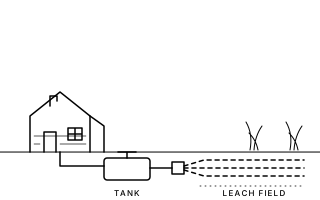
- The inspector must find and inspect the septic tank, distribution box and any cesspools. If something can't be fully inspected, the inspector has to explain why on the form.
- The inspector files the report on MassDEP's official form with the town Board of Health within 30 days, and the seller must give the buyer a copy.
- A passing report means the system works today. It is not a guarantee that it will keep working.
The possible results
| Result | What it means | What usually happens in a sale |
|---|---|---|
| Pass | The system meets Title 5 standards as inspected. | Proceed. Still review the age, pumping history and any I/A maintenance contract. |
| Conditional pass | A fixable component problem, such as a cracked or metal tank, a broken or blocked pipe, an uneven distribution box or a pump chamber that isn't working. The repair must be done and approved by the Board of Health. A leaching field or cesspool cannot get a conditional pass. | Usually the seller makes the repair before closing, or the parties negotiate a credit. |
| Fail | The system does not protect public health and the environment. The owner must upgrade it, generally within 2 years, unless the Board of Health or MassDEP sets a different schedule. That applies whether or not the property sells. | Replacement before closing, a price reduction or credit, an escrow holdback, or a buyer's upgrade agreement with the Board of Health. See below. |
The official inspection form can also flag a system for further evaluation by the Board of Health. If you see that box checked, ask the health department what it means for that property before you go further.
Older Cape cottages sometimes still have a cesspool (a pit with no separate septic tank) instead of a septic system. Inspectors must locate and inspect cesspools, and a cesspool can't be fixed under a conditional pass. If the listing or the town file shows a cesspool, plan on replacement or sewer connection being part of the deal, and have your inspector and attorney confirm how the current code treats that specific system.
If the system fails: how deals get done
A failed Title 5 does not have to kill a sale. On the Cape it happens often enough that local attorneys, lenders and installers have well-worn paths:
Seller replaces before closing
Cleanest for the buyer and lender. Ask for the Board of Health Certificate of Compliance and the as-built plan before closing. Design, permitting and installation take time, especially in spring and summer, so build that into your timeline.
Price reduction or seller credit
The buyer takes on the replacement. Get a designer's estimate and at least one installer quote before agreeing on a number. Lender rules on credits vary, so ask your lender.
Escrow holdback
Part of the seller's proceeds is held at closing (often by the closing attorney) until the work is done, usually with a cushion above the estimate. Whether this is allowed, and on what terms, depends on the lender and the loan program. Your attorney drafts the agreement.
Buyer's upgrade agreement with the Board of Health
Title 5 lets a buyer sign a binding, disclosed agreement with the Board of Health to upgrade the system, or connect to sewer, within 2 years after the transfer. Some towns set shorter periods for failed or very old systems. This is common when sewer is coming soon. Ask the town early.
What does a replacement cost? It depends heavily on lot size, soils, groundwater depth, distance to wetlands or water, whether a nitrogen-reducing (I/A) system is required, and engineering and permitting. We don't publish a "typical" number because conditions vary too much from lot to lot. Get a site-specific estimate from a Title 5 designer or engineer and a licensed installer. For financing, see AquiFund and the state tax credit below.
Ask whether a Title 5 report already exists and when it was done. Ask for pumping records too, since a 3-year validity depends on them. Make your offer contingent on a satisfactory Title 5 result if no report exists yet. If you're financing, tell your lender about a failed or conditional report right away. Lenders and appraisers handle septic issues differently, and the loan program can limit your options. Learn more in our Buyer Academy.
The 2023 nitrogen rules (Nitrogen Sensitive Areas)
In 2023 MassDEP adopted two related sets of rules: amendments to Title 5 (310 CMR 15.000) creating Natural Resource Nitrogen Sensitive Areas (NSAs), and a new Watershed Permit regulation (314 CMR 21.00). Details here come from MassDEP's official FAQ and its watershed permit status table (as of June 11, 2026).
What the rules say
- Effective July 7, 2023. Cape Cod watersheds with an EPA-approved nitrogen limit (a "TMDL") became NSAs automatically on that date. The Wellfleet Harbor watershed, which serves Eastham, Truro and Wellfleet, was designated on September 29, 2023. More watersheds can be added as new nitrogen studies are approved.
- A 2-year window. After a watershed is designated, towns have 2 years to file with MassDEP. Towns could file a Notice of Intent (NOI) to apply for a watershed permit, a full watershed permit application, or a "de minimis" nitrogen-load exemption. For the original Cape watersheds the window ran to July 7, 2025, and for Wellfleet Harbor to September 29, 2025.
- If the town doesn't file: every septic system in the NSA must be upgraded to Best Available Nitrogen Reducing Technology (BANRT) within 5 more years. MassDEP describes that as within 7 years of the rules taking effect, or about July 2030 for the original watersheds.
- If the town does file: the 5-year upgrade clock never starts for homeowners in that watershed. Instead, the town takes responsibility for cutting nitrogen through its watershed plan (sewers, I/A systems, aquaculture and so on) under a permit that runs up to 20 years. If the town later misses the deadlines in its approved schedule, or the permit is withdrawn or revoked, the homeowner upgrade requirement comes back with new deadlines.
- New construction. In an NSA, new construction must use BANRT unless the town made a qualifying filing. MassDEP pushed that start date to July 8, 2024 for all 31 Cape watersheds. Drinking-water NSA rules, which existed before 2023, are unchanged.
- Recent upgrades. A system that was upgraded with MassDEP-approved nitrogen-reducing technology in the 10 years before the rules took effect generally doesn't have to be upgraded again. Exceptions include a system that fails, a change in use, or a major alteration.
Where things stand in 2026
According to MassDEP's June 11, 2026 table, every Cape town with a designated NSA has made a filing. Most filed NOIs. Barnstable filed a full town-wide watershed permit application, Brewster filed one for its Herring River watershed, and Brewster and Mashpee filed de minimis exemptions for certain small watersheds. The Pleasant Bay Watershed Permit, shared by Brewster, Chatham, Harwich and Orleans, was the first watershed permit in Massachusetts and is listed as an existing permit. Provincetown does not appear on the table. See the town table below.
Because the towns filed, most Cape owners do not currently face a state deadline to install a nitrogen-reducing septic system. But the town's plan is how the nitrogen problem gets solved. That usually means sewer assessments, connection costs and connection deadlines in some neighborhoods, and possibly required I/A systems in others. A town that misses its schedule can bring back the individual upgrade requirement. Local Boards of Health can also adopt rules stricter than Title 5. Ask what the plan calls for on your street.
How to check a specific property
Is it in an NSA?
Use MassDEP's NSA map with address lookup.
What has the town filed?
Look up the town and watershed on MassDEP's watershed permit status table.
What does the town plan for that street?
Check the town's wastewater plan and sewer maps. In Barnstable, use the CWMP Property Look-Up Map. Otherwise, call the town's DPW or wastewater office and the Board of Health.
Ask about disclosure
MassDEP publishes an NSA property disclosure template form, available from the watershed permit regulation page. Ask your attorney whether and how NSA status should be disclosed in your transaction.
Innovative/Alternative (I/A) septic systems
An I/A system is a septic system with added treatment, usually to remove nitrogen. Under the 2023 rules, "BANRT" means, in order of priority:
- a MassDEP general-use-approved alternative system that achieves 10 mg/L total nitrogen or less;
- if none fits, the general-use system with the lowest nitrogen value;
- or provisionally approved or piloted systems that meet the applicable limits.
The system also has to be approved for the building's use and design flow.
- Installation cost: MassDEP's 2023 FAQ cited $17,000–$36,000 for installation, based on information from two nitrogen-removal technologies. It noted that the cost depends on the existing system and the site. Treat that as a 2023 reference point, not a quote.
- Ongoing costs: I/A systems need an operation & maintenance (O&M) contract and regular sampling. MassDEP's FAQ notes that provisional-use systems require quarterly monitoring, general-use systems annual monitoring, and many systems also use electricity. Ask the seller for the O&M contract, recent service reports and sampling results, and get a renewal price from the service provider.
- Testing & research: Barnstable County runs the Massachusetts Alternative Septic System Test Center (MASSTC) in Falmouth, where I/A technologies are tested.
- I/A vs. sewer: In Barnstable, the town's wastewater FAQ says currently approved I/A systems don't remove enough nitrogen to meet Barnstable's nitrogen targets, which is part of why the town leans on sewers. Other towns rely on I/A more heavily. Ask the town.
Loans, tax credits & subsidies
Cape Cod AquiFund (county loans)
Barnstable County's Community Septic Management Loan Program makes betterment loans for septic repair and replacement, I/A upgrades and sewer connections, with terms up to 20 years. Listed rates are 0%, 2%, 4% and 5%, subject to change. The 0% and 2% rates are only for new sewer connections at owner-occupied, year-round single-family primary homes. Septic repairs and I/A upgrades are 4%. Properties on the market get only the 5% rate, and the unpaid balance is due when the property is sold or transferred. Rentals and seasonal homes don't qualify for 0% or 2%.
State septic tax credit
Massachusetts' septic credit, claimed on Schedule SC, covers 60% of eligible costs to repair or replace a failed septic system or connect to sewer, up to $18,000 total, with no more than $4,000 per year. This applies to tax years beginning on or after January 1, 2023, per Mass.gov's summary of the 2023 tax law. Ask your tax preparer about eligibility, such as primary residence, carryforward and whether it's refundable.
Cape Cod & Islands Water Protection Fund
Funded by a 2.75% excise on hotel and short-term rental stays, the fund subsidizes town water-quality projects through the state Clean Water SRF: 25% of project cost for projects over $1 million and 50% for smaller ones. It goes to towns, not homeowners, but it lowers what towns must recover through assessments and rates.
Some towns have their own assistance programs. Barnstable, for example, lets owners pay its sewer assessment over 30 years. Ask the town, and see the Barnstable Sewer Connection Center for that town's financing options.
Town-by-town: watershed permits & wastewater plans
The status column comes from MassDEP's watershed permit application table dated June 11, 2026. "NOI" means the town filed a Notice of Intent to pursue a watershed permit, which keeps the individual homeowner upgrade clock from starting. The "Water Protection Fund" note means the town has received subsidy awards listed by the Cape Cod Commission. Plans change often, so confirm with the town before you rely on any line here.
| Town | Watershed permit status (MassDEP, 6/2026) | Wastewater plan notes | More info |
|---|---|---|---|
| Barnstable | Application filed Town-wide watershed permit application covering 7 watersheds (filed Sept. 1, 2023). The town reported a draft permit issued for public comment June 11, 2025. Confirm whether it has been finalized. | 30-year CWMP (approved 2021) in three 10-year phases. Sewer expansion is underway. See details below. Water Protection Fund recipient. | Barnstable Water Resources · Town guide |
| Bourne | NOI Phinney's Harbor; Megansett–Squeteague Harbor | Water Protection Fund recipient. | Town guide · ask Bourne DPW / Board of Health |
| Brewster | Permit Pleasant Bay (existing permit) · Application Herring River · De minimis: Swan Pond, Bass River | Party to the Pleasant Bay Watershed Permit. | Pleasant Bay permit · Town guide |
| Chatham | Permit Pleasant Bay · NOI Taylors Pond/Mill Creek, Sulphur Springs/Bucks Creek, Stage Harbor | Shares wastewater treatment with Harwich. Water Protection Fund recipient. | Pleasant Bay permit · Town guide |
| Dennis | NOI Swan Pond River, Bass River, Herring River | Water Protection Fund recipient. | Town guide · ask Dennis DPW / Board of Health |
| Eastham | NOI Wellfleet Harbor (designated 9/29/2023) | Water Protection Fund recipient. | Town guide · ask Eastham Board of Health |
| Falmouth | NOI 13 watersheds, including Little Pond, Great Pond, Green Pond, Bournes Pond, Eel Pond/Waquoit Bay, West Falmouth Harbor, Falmouth Inner Harbor and Megansett Harbor | Water Quality Management Committee formed in 2011 to draft the CWMP. Water Protection Fund recipient. | Falmouth WQMC · Town guide |
| Harwich | Permit Pleasant Bay · NOI Wychmere Harbor, Herring River, Saquatucket Harbor, Allen Harbor | Harwich's first sewers are tied to a shared treatment partnership with Chatham. Water Protection Fund recipient. | Pleasant Bay permit · Town guide |
| Mashpee | NOI Waquoit Bay, Popponesset Bay · De minimis: Bournes Pond, Three Bays, Green Pond | Nitrogen-sharing agreement with Sandwich and Barnstable for Popponesset Bay. Community-scale shared septic in the Mashpee–Wakeby area. Water Protection Fund recipient. | Mashpee Sewer Commission · Town guide |
| Orleans | Permit Pleasant Bay (existing permit) | Party to the Pleasant Bay Watershed Permit. Water Protection Fund recipient. | Pleasant Bay permit · Town guide |
| Provincetown | Not listed Not on MassDEP's June 2026 table | Water Protection Fund recipient. Check the NSA map for any specific property. | Town guide · ask Provincetown DPW |
| Sandwich | NOI Three Bays, Popponesset Bay, Waquoit Bay | Part of the Popponesset Bay nitrogen-sharing agreement with Mashpee and Barnstable. | Town guide · ask Sandwich Board of Health |
| Truro | NOI Wellfleet Harbor (designated 9/29/2023) | No Water Protection Fund awards listed by the Commission. | Town guide · ask Truro Board of Health |
| Wellfleet | NOI Wellfleet Harbor (designated 9/29/2023) | Water Protection Fund recipient. | Town guide · ask Wellfleet Board of Health |
| Yarmouth | NOI Parker River, Lewis Bay, Bass River | Water Protection Fund recipient. | Town guide · ask Yarmouth DPW / Board of Health |
For each town's full plan, its schedule and which streets are in which phase, contact the town's DPW, wastewater or water quality office and the Board of Health. Ask specifically about sewer assessments or betterments, mandatory connection rules and local septic regulations that go beyond Title 5.
Barnstable in detail (Hyannis, Centerville, Osterville, Cotuit, Marstons Mills, West Barnstable, Barnstable Village)
Barnstable's Comprehensive Wastewater Management Plan is a 30-year plan in three 10-year phases. The Cape Cod Commission found it consistent with the 208 Plan on April 16, 2021. The town reports that Phase 1 includes 16 sewer expansion projects and about 90 miles of new sewer, and is expected to remove roughly 44% of the nitrogen affecting local waters. Projects reported in the town's FY2024 CWMP annual report and on its website:
| Project | Approx. properties | Status / schedule (as reported) |
|---|---|---|
| Strawberry Hill Road (Centerville River watershed) | ~215 | Built (broke ground Sept. 2021). First residential connections in May 2024. |
| Route 28 East | ~100 | Substantially complete March 2024. Includes the plan's largest pump station at Route 28 & Phinney's Lane. |
| Centerville Village, North & South phases | ~220 north / ~150 south | North phase expected to finish FY2026. South phase scheduling followed. Confirm current dates with DPW. |
| Route 28 West | ~230 | Funded ($59.65M). Construction planned FY2025–FY2027. Includes decommissioning the Marstons Mills treatment plant and supports future service toward Osterville. |
| Phinney's Lane neighborhoods | ~590 | Construction was planned for FY2026–FY2028. The town held a public meeting on upcoming construction on October 7, 2026. |
| Long Pond area | ~520 | Planned FY2027–FY2030 |
| Long Beach | ~160 | Planned FY2027–FY2028 |
| Old Yarmouth Road | ~130 | Planned FY2028–FY2029 |
| Great Marsh Rd / Shootflying Hill Rd | ~240 | Planned FY2028–FY2029 |
| Old Craigville Road | ~440 | Planned FY2030–FY2031 |
Schedules were reported in FY2024 and do shift. The town also approved $109 million in 2024 to upgrade its Hyannis treatment plant, including nitrogen removal. Properties in Phase 2 (years 11–20) and Phase 3 (years 21–30) don't have detailed schedules yet.
What Barnstable sewer costs a homeowner
From the town's Anticipated Costs page and FAQ:
- Sewer assessment: a one-time charge of the lesser of $10,000 per sewer unit or the allocated infrastructure cost, under the ordinance adopted July 1, 2021. A dwelling with one bedroom or fewer counts as a half unit ($5,000). A two-family is assessed twice. The assessment covers the first grinder pump per unit if one is needed. It doesn't apply to existing sewer customers.
- Paying it: in full, or in quarterly installments over 30 years on the tax bill, with interest at 2% above the town's borrowing rate unless the Town Council sets another rate. A lien is recorded at the Registry of Deeds. When a property sells, the lien may pass to the buyer or be paid off at closing. With a mortgage, the lender decides.
- Not included: the private connection from the town's stub at the property line to the house, done by a licensed installer (the town suggests at least three quotes), and decommissioning the old septic system.
- Sewer bills: based on water use. The town says a typical residential bill averages around $435 per year.
- Mandatory connection: under the Board of Health connection policy (amended Dec. 19, 2023), owners must connect within 6 months of the Board's notification letter, or within 60 days if the septic system has failed. Limited extensions are possible.
Look up the address on the CWMP Property Look-Up Map. Then ask the Treasurer/Collector whether an assessment has been levied or a lien recorded, and ask the Health Division whether a connection letter has gone out. A home on a street with sewer already in the ground can carry a $10,000-per-unit assessment plus a connection deadline, so price it into your offer.
When sewer is coming: what it means for buyers
- Assessments and betterments. Towns recover part of sewer costs from the properties that benefit. Some use betterments, some use flat assessments like Barnstable's, and some pay more from town-wide taxes. An unpaid assessment is usually a lien, so ask whether it will be paid at closing or assumed by you, and get it in writing in the purchase and sale agreement. Your attorney and lender will have a view.
- Connection costs. Expect a separate private bill for the line from the street to the house, possibly a grinder pump, plumbing changes and abandoning the septic tank. Get quotes early.
- Mandatory connection. Once sewer reaches the street, the Board of Health can require connection on a deadline, even if your septic passed Title 5.
- I/A now or wait for sewer? If the septic fails and sewer is a few years away, ask the Board of Health about a temporary fix or a binding agreement to connect within 2 years instead of a full new system. Barnstable's FAQ says the Board of Health and DPW try to avoid new Title 5 systems going in where sewer is imminent. If sewer is decades out, an I/A system may be what the town plan calls for. Ask before you spend.
- Upside. A sewered home usually has fewer septic-related restrictions. That can affect things like bedroom count and expansion, but rules vary, so confirm with the town.
Buyer checklist
Questions to ask (listing agent, seller, town)
- Is the home on septic, cesspool, shared system or town sewer? If septic, is it conventional or I/A?
- Is there a Title 5 report from the last 2 years (or 3 with annual pumping records)? What was the result?
- How many bedrooms is the septic system designed for, and does that match how the home is marketed?
- Is the property in a Nitrogen Sensitive Area, and what has the town filed for that watershed?
- Is sewer planned for this street? Which phase or year? Has an assessment or betterment been levied, and has a lien been recorded?
- Has the Board of Health sent a sewer connection letter or any violation notice?
- Is the property in a drinking-water protection area or near wetlands or water, where stricter local rules may apply?
Documents to request
- The full Title 5 inspection report on MassDEP's official form, plus any earlier reports
- Pumping records for at least the last few years
- The as-built plan and the Board of Health Certificate of Compliance for the current system
- For an I/A system: the O&M contract, recent service reports and sampling results, and the renewal cost
- Any Board of Health variances, orders or upgrade agreements on the property
- Any sewer assessment or betterment notice, and the tax bill showing installments
- For a failed system: the engineer's design, permit status, installer quotes and draft escrow or holdback terms
How to pull the town's septic file
- Contact the town's Board of Health / Health Department and ask for the septic (Title 5) file for the address or parcel ID. Many towns have records online or can email them, and some require a public records request.
- Look for: original permit and as-built plan, Certificates of Compliance, all Title 5 inspection reports, variances, I/A monitoring results and any open violations.
- Compare the design flow and bedroom count in the file against the listing.
- Ask the DPW or wastewater office for the sewer timeline, and the Treasurer/Collector about assessments.
FAQ
Who pays for the Title 5 inspection?
Title 5 puts the duty to arrange it on the current owner, which in practice is usually the seller. Buyers and sellers can agree otherwise in writing before closing. Who pays is negotiable and handled in the offer and the purchase and sale agreement.
Can I buy a house with a failed septic system?
Yes. Common approaches are seller replacement before closing, a price reduction or credit, an escrow holdback, or a buyer's binding agreement with the Board of Health to upgrade within 2 years. Your lender and loan program may limit which of these you can use, so involve them early.
Do I have to install a nitrogen-reducing septic system?
Not automatically, in most of the Cape right now. Because towns filed for watershed permits or NOIs, the state's 5-year homeowner upgrade requirement hasn't started in those watersheds. But a failed system, new construction, a town that misses its schedule or a local Board of Health rule can still require one. Ask the town about the specific property.
What happened to the July 2025 and July 2030 deadlines?
July 7, 2025 was the end of the 2-year window for towns to file with MassDEP for the original Cape NSAs. July 2030 is when homeowner upgrades would have been due if a town didn't file. MassDEP's June 2026 table shows filings for every designated Cape watershed, so those homeowner deadlines are not currently running. They can return if a town falls off its schedule.
Does a passing Title 5 mean the system will last?
No. It reflects the system's condition on inspection day. Age, pumping history, design capacity and how the home will be used matter too. That last one counts most if you plan to rent the home or add bedrooms.
I'm buying a second home I'll rent out. Does that change anything?
It can. AquiFund's 0% and 2% sewer-connection loan rates are only for owner-occupied, year-round primary residences. The state septic credit has eligibility rules too, so check with your tax preparer. Heavier summer use also affects septic sizing and pumping.
Will my sewer assessment be paid at closing?
It depends on the town and the deal. Unpaid assessments are generally liens, and the purchase and sale agreement should say who pays. In Barnstable, the town says the lien may transfer to the buyer or be paid at closing, and a lender may require payoff.
Resources
- Buying or Selling Property with a Septic SystemTitle 5 inspection rules for sales · MassDEP
- Septic Systems & Title 5Main hub for Title 5 · MassDEP
- 310 CMR 15.000 (Title 5)The regulation text · MassDEP
- Watershed Permit Regulations (314 CMR 21.00) & NSA resourcesRules, FAQ, disclosure template, funding info · MassDEP
- NSA Map with Address LookupCheck if a property is in a Nitrogen Sensitive Area · MassDEP / EEA
- Watershed Permit Application Status TableWhat each town has filed (as of 6/11/2026) · MassDEP
- 2023 NSA & Watershed Permit FAQDeadlines, BANRT, exemptions · MassDEP
- 208 Plan Implementation & Watershed ReportsRegional water quality plan and per-watershed reports · Cape Cod Commission
- Cape Cod & Islands Water Protection FundSubsidies for town wastewater projects · Cape Cod Commission
- State of the Waters: Cape Cod – Action PlanRegional progress on wastewater and water quality · Association to Preserve Cape Cod
- Cape Cod AquiFund (Community Septic Management Loan Program)Septic, I/A and sewer-connection loans · Barnstable County Dept. of Health & Environment
- 2023 Title 5 Regulation Changes (homeowner explainer)Plain-language summary · Barnstable County / MASSTC
- Massachusetts Alternative Septic System Test CenterI/A technology testing · Barnstable County
- 2023 Massachusetts Tax Cuts (septic credit)Septic credit increase to $18,000 · Mass.gov
- Barnstable Water ResourcesBarnstable CWMP, sewer projects, connection center · Town of Barnstable
- Pleasant Bay Watershed PermitBrewster, Chatham, Harwich, Orleans · Pleasant Bay Alliance
Related guides: Well water & flood zones · Town guides · Relocating to the Cape · Start here · All resources
Questions about septic, Title 5 or sewer on a property you're considering?
Call or text Sherman at 508-534-3425 or send a message. He'll help you figure out what to ask, and who to ask, before you commit.