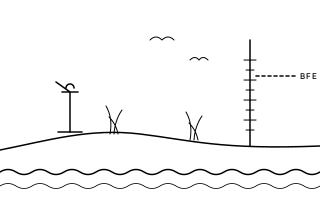
Read the water supplier's annual report (or test the well), check whether the house is in a FEMA flood zone, and get real homeowners and flood insurance quotes before your inspection and mortgage contingencies run out. Those three steps catch most of the expensive surprises buyers run into on the Cape.
One aquifer, one water supply
Nearly all Cape Cod drinking water, public or private, is pumped from the same sandy groundwater system under the peninsula. In 1982 the U.S. EPA designated the Cape Cod Aquifer a Sole Source Aquifer. That means it supplies at least half the drinking water for the area and there's no realistic backup source if it gets contaminated. Federally funded projects on the Cape can be reviewed by EPA to protect it.
For buyers, the takeaway is simple. What goes into the ground here (septic effluent, fertilizer, road runoff, firefighting foam, fuel) can end up in someone's well or a town wellfield. That's why the Cape spends so much attention and money on septic, Title 5 and sewer projects, and why water quality belongs on your due-diligence list.
Public water: who supplies each town
Every community public water system has to publish an annual water quality report (federally called a Consumer Confidence Report, or CCR) listing what was detected and how it compares to limits. Several Cape towns have more than one supplier, and in Barnstable each village area has its own. Some neighborhoods have no public water and rely on private wells. Always confirm the supplier for a specific address. The water bill or the seller's disclosure will name it, and so will the supplier itself.
| Town | Public water supplier(s) | Where to find the water quality report |
|---|---|---|
| Barnstable | Hyannis Water System (Town of Barnstable Water Supply Division); Barnstable Fire District; Centerville-Osterville-Marstons Mills (COMM) Water Department; Cotuit Water Department. Parts of town are on private wells. | Hyannis Water System · COMM Water · Cotuit Water · Barnstable Fire District: contact the district or use EPA's CCR finder |
| Bourne | Bourne Water District; Buzzards Bay Water District; North Sagamore Water District | Contact the district, or EPA's CCR finder |
| Brewster | Brewster Water Department | Annual Water Quality Report |
| Chatham | Chatham DPW Water Division | Drinking water testing & reports |
| Dennis | Dennis Water District | Contact the district, or EPA's CCR finder |
| Eastham | Town of Eastham municipal water system (relatively new; many homes still on private wells) | Consumer Confidence Reports · testing results |
| Falmouth | Town of Falmouth Water Department | Town website, falmouthma.gov (Departments › Water), or EPA's CCR finder |
| Harwich | Harwich Water Department | Harwich Water Department |
| Mashpee | Mashpee Water District | Mashpee Water District |
| Orleans | Orleans Water Department | Annual Water Quality Report |
| Provincetown | Provincetown Water Department | Water Department (annual reports) |
| Sandwich | Sandwich Water District | Contact the district, or EPA's CCR finder |
| Truro | Provincetown Water System serves parts of Truro (its wells are located in Truro). Most developed properties rely on private wells or small public wells. | Truro water page |
| Wellfleet | Wellfleet Municipal Water System (limited service area); most homes on private wells | Water quality report (2023). Ask the town for the latest. |
| Yarmouth | Yarmouth Water Department | 2025 Drinking Water Quality Report |
If a link above doesn't work, every Massachusetts public system's report can also be looked up through EPA's Consumer Confidence Report page.
Look for three things: (1) any violations or exceedances in the last few years, (2) the PFAS results and whether treatment is in place, and (3) the lead and copper results, which matter more if the house is older and might have old plumbing or solder. A report with detections isn't automatically bad news. Labs measure in parts per trillion, so the question is how results compare to the legal limits.
PFAS on Cape Cod
PFAS ("forever chemicals") are a family of man-made compounds found in some firefighting foams and many consumer products. On the Cape, the best-known sources of contamination are past firefighting-foam use at training areas and military and aviation sites. In sandy soil those chemicals travel easily into groundwater.
The rules as of October 2026
- Massachusetts: Since October 2, 2020, MassDEP has enforced a drinking water standard of 20 parts per trillion (ng/L) for the combined total of six PFAS compounds, called "PFAS6" (PFOS, PFOA, PFHxS, PFNA, PFHpA and PFDA). It applies to public water systems and is still in effect.
- Federal (EPA): EPA's April 2024 rule set limits for six PFAS, including 4.0 ppt each for PFOA and PFOS. On May 18, 2026, EPA proposed keeping the PFOA and PFOS limits but rescinding the limits for PFHxS, PFNA, HFPO-DA ("GenX") and the hazard-index mixture. It also proposed letting qualifying systems have until 2031, instead of 2029, to comply with the PFOA/PFOS limits. As of this writing these are proposals, not final rules, and the 2024 rule is also being challenged in court.
- State update coming: MassDEP says it will propose amendments so state rules are at least as strict as EPA's. EPA has given the state until April 26, 2028 to adopt them (MassDEP).
Known local PFAS issues (public record)
- Hyannis Water System (Barnstable): PFAS was found in Hyannis public supply wells, with the Barnstable County Fire Training Academy identified as a major source and the airport (Cape Cod Gateway Airport) as another. Treatment was added to wells in stages between 2015 and 2020, according to a 2024 regional case study. The Town has owned the system since buying it from the Barnstable Water Company in 2005 and is planning new treatment facilities and water sources. See the Town's Water Supply Division page for its PFAS Q&A and project updates.
- Joint Base Cape Cod (Upper Cape): Firefighting foam used at the base decades ago created groundwater plumes that reached some public supply wells and private wells in Mashpee and Falmouth. The Air Force agreed to fund treatment for affected wells, including Mashpee Water District's Turner Road wells (Cape News). EPA oversees cleanup at the base.
For a house on town water, read the supplier's latest report and ask whether any wells are offline or treated for PFAS. For a house on a private well, especially near a known source, test for PFAS (see below). Contamination history in an area doesn't mean a given home's water is unsafe today, and a clean town report doesn't tell you anything about a private well. Each one needs its own data.
Private wells: test before you buy
A large share of Cape homes, especially on the Outer Cape and in parts of the Upper and Mid Cape, get their water from a private well. In Truro, for example, the town says nearly 90% of developed properties rely on private wells or small public wells (Town of Truro). With a private well, you are the water department. Nobody else tests it for you.
Who requires a test?
Private wells are mainly regulated by the local Board of Health, not MassDEP (MassDEP). Some towns have their own well regulations, and many lenders require a water test before closing. Ask the town's health department and your lender what they require for the specific property. Even when nobody requires it, a buyer can and usually should make a well test a condition of the offer.
Where to test
The Barnstable County Water Quality Laboratory (Barnstable County Department of Health and Environment, 3195 Main Street, Barnstable Village; 508-375-6605) tests private well water. Its published price list includes a Routine Well Analysis and a Real Estate Package, with faster turnaround available for a fee. That matters when you're working against a contingency deadline. Several town health departments collect samples and courier them to the lab. The county's free well-testing program from 2025 is full, so plan on paying for testing.
At least one town (Wellfleet) states that the County lab does not currently run PFAS on residential wells. Call the lab to confirm what it offers. If it doesn't run PFAS for private wells, use a MassDEP-certified lab that does. MassDEP's PFAS6 benchmarks for private wells are: under 20 ppt, no action required; 20 to under 90 ppt, considered unacceptable for long-term drinking; 90 ppt or more, immediate action (MassDEP Q&A).
What to test for
- Coliform / E. coli bacteria: sanitary safety of the well
- Nitrate: a common signal of septic or fertilizer influence on the Cape
- Sodium and specific conductance: road salt or saltwater influence near the shore. In Truro's Beach Point area, well water is too salty to drink and homes are on public water (Truro).
- pH, iron, manganese, copper: Cape groundwater tends to be naturally acidic, which can corrode plumbing
- Lead: especially in older homes
- VOCs (volatile organic compounds): fuels and solvents
- PFAS: strongly recommended near known sources (see above)
- Radon in water: optional; ask the lab
For owners, the County recommends testing for bacteria, pH, conductivity, sodium and nitrate every year, and copper, iron, manganese and VOCs every three years (Barnstable County).
Wells and septic systems: distance matters
Because wells and septic systems share the same sandy ground, state Title 5 rules and local Board of Health rules set minimum distances between a well and the septic system, both on the lot and on neighboring lots. Truro, for example, describes a 100-foot protective radius around a private well that limits where septic systems can go (Truro). Local rules can be stricter than the state's. These setbacks often decide where a septic upgrade or addition can go, so read our septic and Title 5 guide together with this section.
Ponds, beaches & cyanobacteria
The Cape has hundreds of freshwater "kettle" ponds, and a pond-front or pond-view home carries a premium. Many ponds are also stressed by nutrients from septic systems and runoff. That can feed cyanobacteria (blue-green algae) blooms, some of which produce toxins that are harmful to people and especially to dogs.
- APCC monitoring: The Association to Preserve Cape Cod runs a cyanobacteria monitoring program with an interactive map of monitored ponds and their status. It samples ponds every two weeks during the season, and more often when a pond shows signs of concern. Official swim advisories come from the town health department.
- State guidelines: The Massachusetts Department of Public Health recommends an advisory when there is a visible scum, cell counts above 70,000 cells/mL, or toxins above guideline values (for example, microcystins at 8 µg/L) (MDPH guidelines).
- Beach bacteria testing: Public and semi-public beaches are tested for bacteria during the swim season, and results and closures appear on the state's Beach Water Quality Dashboard.
Look up the pond's advisory history on APCC's map and ask the town health department about past closures. Ask whether the town has a pond management plan or treatment program. Also ask whether the neighborhood is in a future sewer area. Pond health, septic rules and sewer plans are all connected; see Wastewater & Septic.
Radon (air and water)
Radon is a natural radioactive gas and a known cause of lung cancer. The Massachusetts Department of Public Health recommends that all homes be tested. EPA's action level for indoor air is 4 pCi/L, and EPA suggests considering a fix between 2 and 4 pCi/L (EPA). An air test is a common add-on to a home inspection, and mitigation systems are usually straightforward to install. If the home is on a private well, you can also ask the lab about testing radon in water. The state's Radon Information Line is (800) 723-6695.
Flood zones: what the map letters mean
FEMA's Flood Insurance Rate Maps (FIRMs) assign every property a flood zone. On the Cape the ones you'll see most:
| Zone | What it means | Lender flood insurance? |
|---|---|---|
| VE | Coastal high hazard area: high flood risk plus storm-wave action. Strictest building rules. | Required for federally backed mortgages |
| AE / A | Special Flood Hazard Area (high risk). AE zones show a Base Flood Elevation (BFE). | Required for federally backed mortgages |
| X (shaded) | Moderate risk, generally between the 100-year and 500-year flood limits | Usually not required, but available and often inexpensive |
| X (unshaded) | Minimal mapped risk | Usually not required |
Zone definitions come from FloodSmart (FEMA). FEMA puts the odds this way: a home in a high-risk zone has about a 1-in-4 chance of flooding at least once over a 30-year mortgage.
LiMWA. Many Cape coastal maps also show a line called the Limit of Moderate Wave Action (LiMWA) inside AE zones. The area between the LiMWA and the VE zone can still get damaging waves, and some towns apply stricter construction standards there. If you see that line on or near a lot, ask the town building department what it means for that property.
How to check a specific address
Look up the official map
Search the address on the FEMA Flood Map Service Center. Use the "dynamic map" view to zoom in to the house and the zone line. Massachusetts map data is also available through MassMapper and the MassGIS Data Hub.
Check the building, not just the lot
A lot can be partly in a flood zone. Lenders look at whether the structure touches the zone, and a land surveyor can tell you.
Ask for the Elevation Certificate
An Elevation Certificate is a surveyor's form recording the home's elevations compared with the flood elevation. Ask the seller whether they have one; the town building department may have one on file too. It can reduce flood premiums and is required for some permits.
Ask about prior flooding and claims
Ask the seller in writing about past flood events, flood claims and any FEMA-funded mitigation.
Flood insurance
A standard homeowners policy does not cover flood (MA Division of Insurance). Massachusetts law doesn't require flood insurance, but if the building is in an A or V zone and you have a federally backed mortgage, your lender will require it. You can also buy it voluntarily anywhere.
- NFIP (federal) coverage limits: up to $250,000 for the building and $100,000 for contents on a home (FloodSmart). Many Cape homes cost more than that to rebuild, which is one reason buyers look at private flood policies or excess flood coverage.
- Waiting period: NFIP coverage normally starts 30 days after purchase, but there is no wait when the policy is bought in connection with making a mortgage loan. That's the usual case at closing.
- Current pricing ("Risk Rating 2.0"): NFIP premiums are no longer based mainly on the zone and elevation. They also consider flood frequency, distance to water, multiple flood types (including storm surge) and rebuilding cost (FloodSmart). Two houses in the same zone can have very different premiums, so get a quote for the actual property.
- Mitigation features help: A higher first floor, proper flood vents in crawlspaces and enclosures, and elevated mechanical equipment can lower the premium (FloodSmart discounts).
- Private flood insurance: Private insurers also write flood coverage, sometimes with higher limits (MA DOI). Ask your lender whether it will accept a particular private policy.
Under NFIP rules, the seller can generally assign their flood policy to the buyer in writing when title transfers. Exceptions include contents-only policies and buildings under construction (FloodSmart definitions). Depending on the policy's history, taking over the seller's policy can cost less than starting a new one. Ask the seller for a copy of the current declarations page early, and have your insurance agent compare assignment with a new policy.
Sea level rise, erosion & waterfront permits
Looking ahead
FEMA maps show today's mapped risk, not the future. The NOAA Sea Level Rise Viewer lets you see which areas could be affected under different sea level and high-tide flooding scenarios. NOAA calls it a screening tool, not a basis for permitting. The Cape Cod Commission's climate work covers regional planning for coastal hazards. On the ocean- and bay-facing shore, erosion of coastal banks and dunes is a separate risk from flooding and isn't covered by flood insurance. For a bluff or beachfront property, ask about past erosion, existing shore protection and whether it was permitted.
Conservation Commission: additions, decks, docks and tree work
Under the Massachusetts Wetlands Protection Act, the town Conservation Commission permits work in and near wetlands and coastal resource areas (beaches, dunes, coastal banks, salt marsh, land subject to coastal storm flowage). Its jurisdiction extends into a buffer zone, generally 100 feet from the resource area. Many Cape towns also have their own, stricter wetlands bylaws or ordinances. Barnstable, for example, has a local wetlands chapter and a specific regulation for activity in the 100-foot buffer zone (Barnstable Conservation). In practice, plans for an addition, pool, new deck, septic replacement, vista pruning or dock near water usually need a filing (a Request for Determination of Applicability or a Notice of Intent). Approval isn't guaranteed. Ask the commission before you price your plans into an offer.
Chapter 91: docks, piers and floats
Building a pier, wharf, float, seawall or similar structure in tidal waters, or in a "great pond" (generally a pond over 10 acres in its natural state), requires authorization under Chapter 91, the state's waterways licensing program, as well as local approvals. Licenses are recorded at the Registry of Deeds. If a listing advertises a dock, have your attorney confirm a valid Chapter 91 license (and any local permits) is recorded. A dock without one can be a costly problem. Moorings are a different system run by the town harbormaster, and they generally don't transfer with the house.
Homeowners insurance on the Cape
Getting homeowners insurance close to the water is harder and more expensive than inland. Under Massachusetts law an insurer is not required to write or renew a homeowners policy (MA DOI FAQ), and some companies limit new coastal business. The Division of Insurance publishes a list of companies issuing home policies by county, which helps you see who is actively writing in Barnstable County.
Wind and hurricane deductibles
Wind damage is normally covered by homeowners insurance, but many coastal policies carry a separate wind or hurricane deductible (MA DOI). On the Cape it's often a percentage of the dwelling coverage rather than a flat dollar amount. Do the math: on a hypothetical policy with $800,000 of dwelling coverage, a 2% deductible means the first $16,000 of a hurricane claim is yours. Ask each insurer exactly what triggers the deductible and what percentage applies.
The Massachusetts FAIR Plan (MPIUA)
The Massachusetts Property Insurance Underwriting Association (MPIUA, the "FAIR Plan") is the insurer of last resort for people who can't get coverage from the regular market. It writes many coastal policies on the Cape. Key points (MA DOI):
- You must certify you made a reasonable effort to find coverage elsewhere, and the property must be maintained (not vacant or condemned) with no outstanding tax liens.
- It does not cover flood. Since 2025, new MPIUA policies on properties in Special Flood Hazard Areas in coastal-zone communities require a separate flood policy.
- Its named-storm deductible applies to hurricanes and tropical storms named by the National Weather Service. The period begins 12 hours before a watch or warning is issued for any part of Massachusetts and ends 12 hours after it's lifted.
- FAIR Plan policyholders can move to a regular insurer at any time. The MPIUA "Clearinghouse" lets participating insurers review FAIR Plan homes (Clearinghouse FAQ).
Insurance tips for buyers
- Get quotes early. Ask an agent for homeowners and flood quotes as soon as your offer is accepted, well before your inspection and mortgage contingencies expire. A surprise premium can change your budget.
- Ask the seller for loss history. Prior claims on the house (shown on a CLUE loss-history report, which the seller can request about their own property) can affect eligibility and price.
- Know the roof age and the key systems. Insurers ask about roof age and condition, the electrical service, heating (including oil tanks) and plumbing. Get them from the inspection and the seller.
- Ask about mitigation credits. Hurricane straps, a wind-rated roof, impact glass or shutters and gable-end bracing may earn discounts with some insurers (Resilient Homes).
- Ask about oil-spill coverage if the home heats with oil. It has to be in place before a leak happens (MA DOI).
- Planning to rent the home short-term? Tell your agent. Standard homeowners policies may not fit (DOI: short-term rental insurance).
Buyer checklist: water, flood & insurance
- Confirm public water vs. private well for the address, and identify the supplier.
- Town water: read the latest annual water quality report (violations, PFAS, lead/copper).
- Private well: write a water test into the offer; order the County Real Estate Package or equivalent, plus PFAS from a certified lab; ask about well age, depth and location.
- Check well-to-septic distances and the septic status; see the septic guide.
- On a pond: check APCC and town advisory history.
- Test radon in air (and in water if on a well).
- Look up the FEMA flood zone for the structure; request any Elevation Certificate.
- Get flood insurance quotes (NFIP and private) and ask about assigning the seller's NFIP policy.
- Get homeowners quotes; confirm wind/hurricane deductible terms; ask for loss history and roof age.
- Planning changes near water? Talk to the Conservation Commission first; verify Chapter 91 licenses for any dock.
- Check the NOAA Sea Level Rise Viewer and ask about erosion on coastal-bank or dune properties.
New to buying here? Start with Start Here and the Buyer Academy. Moving from off-Cape? See Relocating to Cape Cod. VA buyers: see VA loans on the Cape for lender water and property requirements.
Frequently asked questions
Does Massachusetts require a well water test when a house is sold?
There's no single statewide requirement for a private well test at sale. Private wells are mainly overseen by the local Board of Health, and requirements vary by town and by lender. Ask the town health department and your lender, and consider making a water test a condition of your offer either way.
Is Cape Cod tap water safe?
Public water systems must test regularly and meet state and federal standards, and each one publishes an annual report showing results. Read the report for the specific supplier. Private wells aren't tested by anyone unless the owner does it.
What's the PFAS limit in Massachusetts right now?
MassDEP's standard of 20 ppt for the sum of six PFAS ("PFAS6") is in effect for public water systems. EPA's federal limits of 4.0 ppt for PFOA and PFOS remain, while EPA's May 2026 proposal to rescind limits on four other PFAS and extend the PFOA/PFOS deadline had not been finalized at last review. Check the MassDEP PFAS page for updates.
The house is in Zone X. Do I need flood insurance?
Your lender usually won't require it in Zone X, but flooding happens outside mapped zones too, and Zone X premiums are often modest. It's worth getting a quote, especially near marshes, low roads or tidal rivers.
Can I take over the seller's flood insurance?
Generally yes for NFIP building policies. The seller can assign the policy in writing at transfer of title (contents-only policies and buildings under construction are exceptions). Have your agent compare assignment with a new policy.
Why is my homeowners quote so high, or why was I declined?
Distance to the coast, wind exposure, roof age, prior claims and the insurer's own appetite for coastal business all play a role. Ask your agent to shop multiple carriers. If no carrier in the regular market will write it, the FAIR Plan (MPIUA) is the market of last resort.
Does the dock come with the house?
A dock structure is part of the property, but it needs proper licensing (Chapter 91 and local permits). Moorings are generally assigned by the town harbormaster and don't automatically transfer. Have your attorney verify.
Resources
- FEMA Flood Map Service CenterOfficial flood maps; search by address · FEMA
- What is my flood zone?Zone definitions and pricing factors · FEMA FloodSmart
- Buying NFIP flood insuranceCoverage limits and the 30-day wait (and its loan-closing exception) · FEMA FloodSmart
- Sea Level Rise ViewerFuture inundation and high-tide flooding scenarios · NOAA
- MassMapperState interactive map with GIS data layers · MassGIS
- PFAS in drinking waterState PFAS6 standard and updates · MassDEP
- EPA PFAS drinking water regulationFederal rule status · U.S. EPA
- Residential water testingWell test packages and prices · Barnstable County Water Quality Laboratory
- Find your water quality reportLook up any public water system's CCR · U.S. EPA
- Cyanobacteria monitoringPond bloom map and status · Association to Preserve Cape Cod
- Beach Water Quality DashboardBeach testing results and closures · MA Dept. of Public Health
- RadonTesting guidance and Radon Information Line · MA Dept. of Public Health
- Chapter 91 waterways licensingDocks, piers and floats · MassDEP
- Home insuranceConsumer guides, FAIR Plan, insurers by county · MA Division of Insurance
- MPIUA (FAIR Plan)Insurer of last resort; named-storm deductible info · MPIUA
Questions about water, flood or insurance on a specific property?
Call or text Sherman at 508-534-3425 or send a message.